
Offshore Renewable Energy Research Group
OFFSHORE RENEWABLE ENERGY
Offshore Renewable Energy Research Group conducts studies on the safety assessment of floating offshore wind turbines, which are expected to become a major power source in the future, as well as research on next-generation technologies such as wave, tidal, and ocean current power generation.
Members
(◎: Head of the Group)
Research Subjects
1. Mooring System Failure Detection Methods for Floating Offshore Wind Turbines Using Motion Measurement
To promote the future adoption of floating offshore wind turbines (FOWTs) as a major power source, the large-scale deployment of FOWTs in the deep waters surrounding Japan is currently being considered. Floating structures maintain their position using mooring systems composed of chains and ropes. Although these systems are designed so that the facility does not immediately drift even if a single line fails, it remains essential to detect such anomalies at an early stage. However, directly inspecting chains and ropes deployed in deep water becomes increasingly costly, making the development of safe and practical inspection methods an important challenge.
In this study, through tank experiments and numerical analyses, we are developing a practical method for detecting anomalies–such as line failure–in mooring systems by using horizontal motion data of the floating structure obtained via Differential GPS (DGPS).
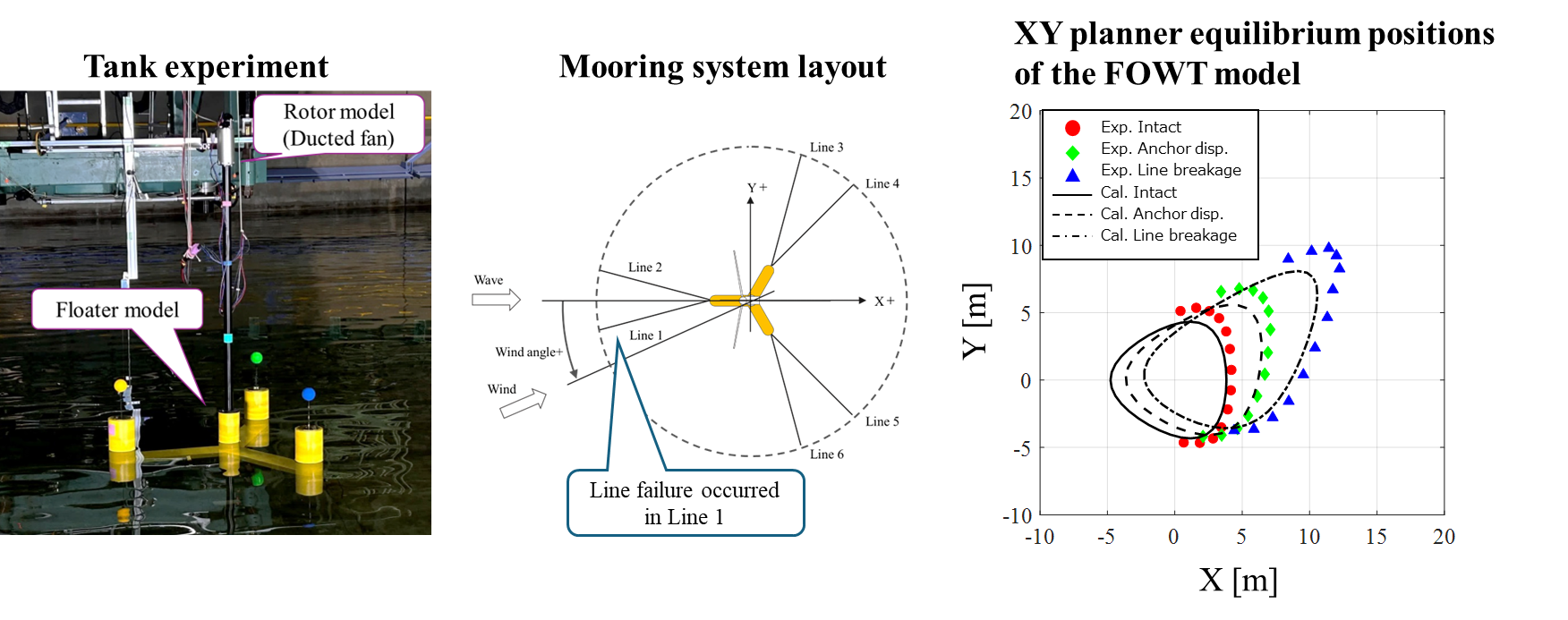
Floating wind turbine model in the Ocean engineering basin
2. Development of Control Methods for Wave Energy Converters
Wave energy is due to its low regional variability, making it suitable as an alternative power source for areas with distributed energy needs such as remote islands. However, wave energy conversion technology remains less advanced compared to other marine renewable energy sources, facing key challenges in operational safety, energy efficiency improvement, and cost reduction. One major issue is the difficulty of operation under conditions with large wave heights. In such scenarios, efficiency decreases, or additional equipment becomes necessary to ensure the device's safety, leading to increased power generation costs. Consequently, developing advanced control methods capable of maximizing power generation while adhering to physical constraints is essential.
Our research group is actively engaged in creating effective control strategies to advance wave energy converters. As illustrated in the figure below, incorporating operational conditions leads to a significant reduction in the annual average output power when conventional control methods are applied. However, with the implementation of the developed control method, it becomes possible to maintain the annual average output power. This improvement is achieved by enabling the system to operate efficiently across a wider range of conditions, ensuring optimal performance while respecting physical constraints. Furthermore, we are developing technologies to evaluate power generation performance and ensure device safety under control, utilizing both numerical simulations and tank experiments.
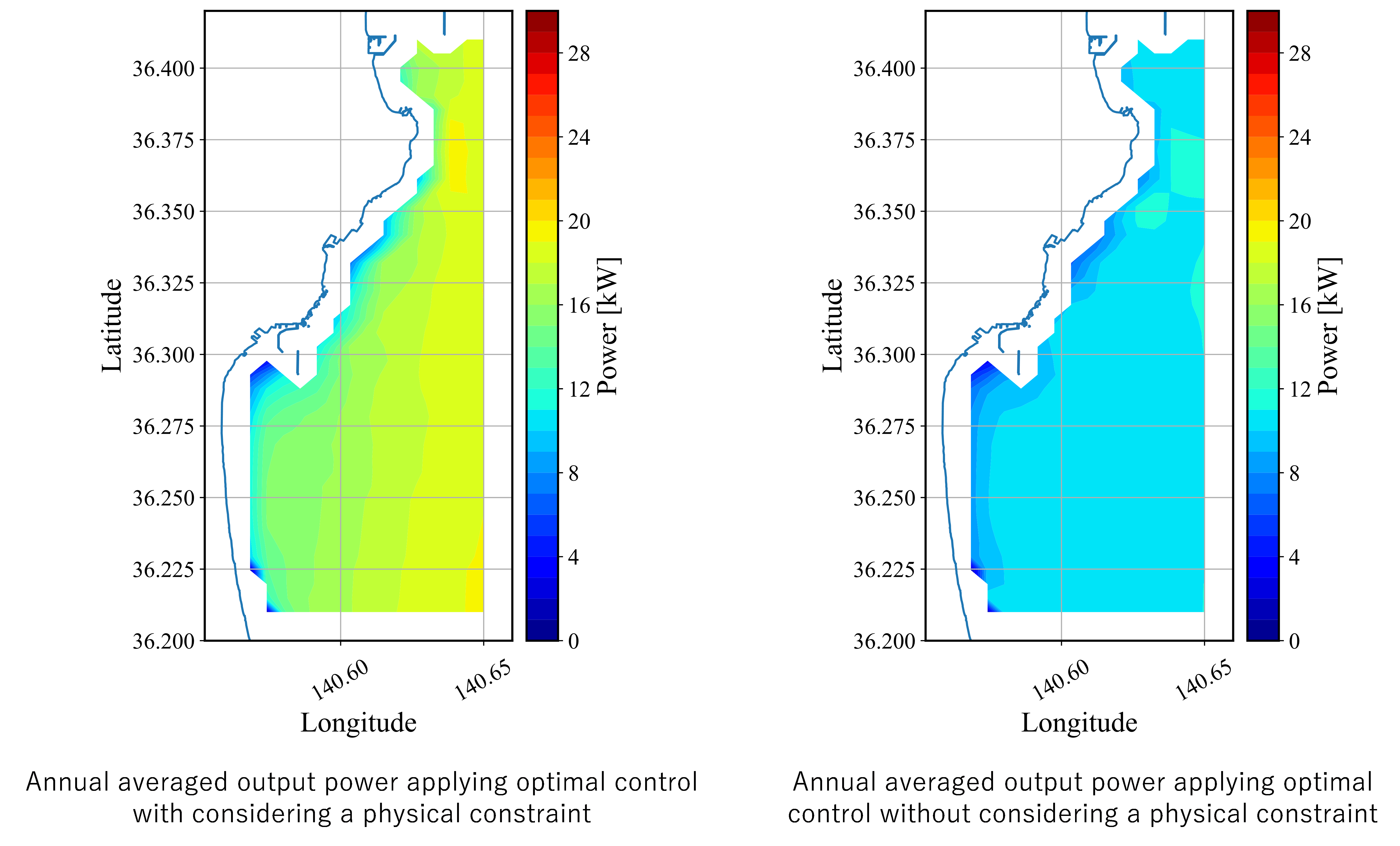
Deference of annual averaged output power between with and without consideration of a physical constraint
3. R & D of synthetic fiber rope mooring system
Floating facilities maintain their position using chains and synthetic fiber ropes. Synthetic fiber ropes are lighter than chains and are expected to reduce both construction and installation costs. Depending on the mooring configuration, it is also possible to minimize the sea area occupied. However, since synthetic fiber ropes are relatively new materials and their properties vary significantly depending on the type, it is necessary to establish methods for safety evaluation.
We are verifying the safety of mooring system through numerical simulations and tank tests. In addition, to enable evaluation at an early stage of the design process, we are developing an initial design software for synthetic fiber rope mooring systems that can accommodate various types. Furthermore, to address uncertainties regarding the effects of biofouling during practical use, we are conducting immersion tests in actual sea areas to evaluate its impact.
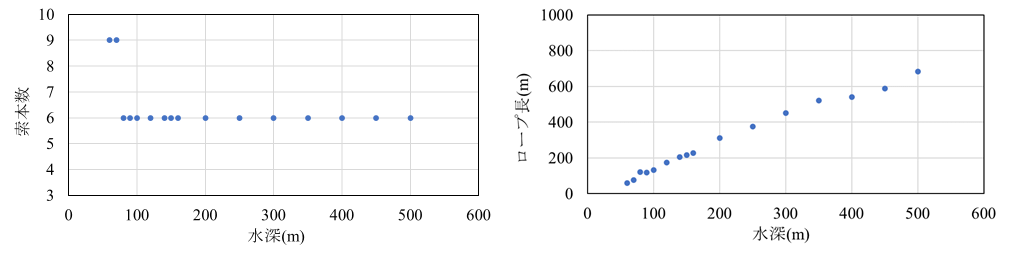
Example of calculation results from the preliminary design program
4. Human Resource Development Initiatives
We are responsible for organizing a university student seminar hosted by the Nippon Foundation Ocean Innovation Consortium, providing educational programs on floating offshore wind power through water tank experiments. In addition, the event also includes guided tours for elementary school students to promote early interest and understanding of ocean engineering.
 Offshore Wind Power Project Team